
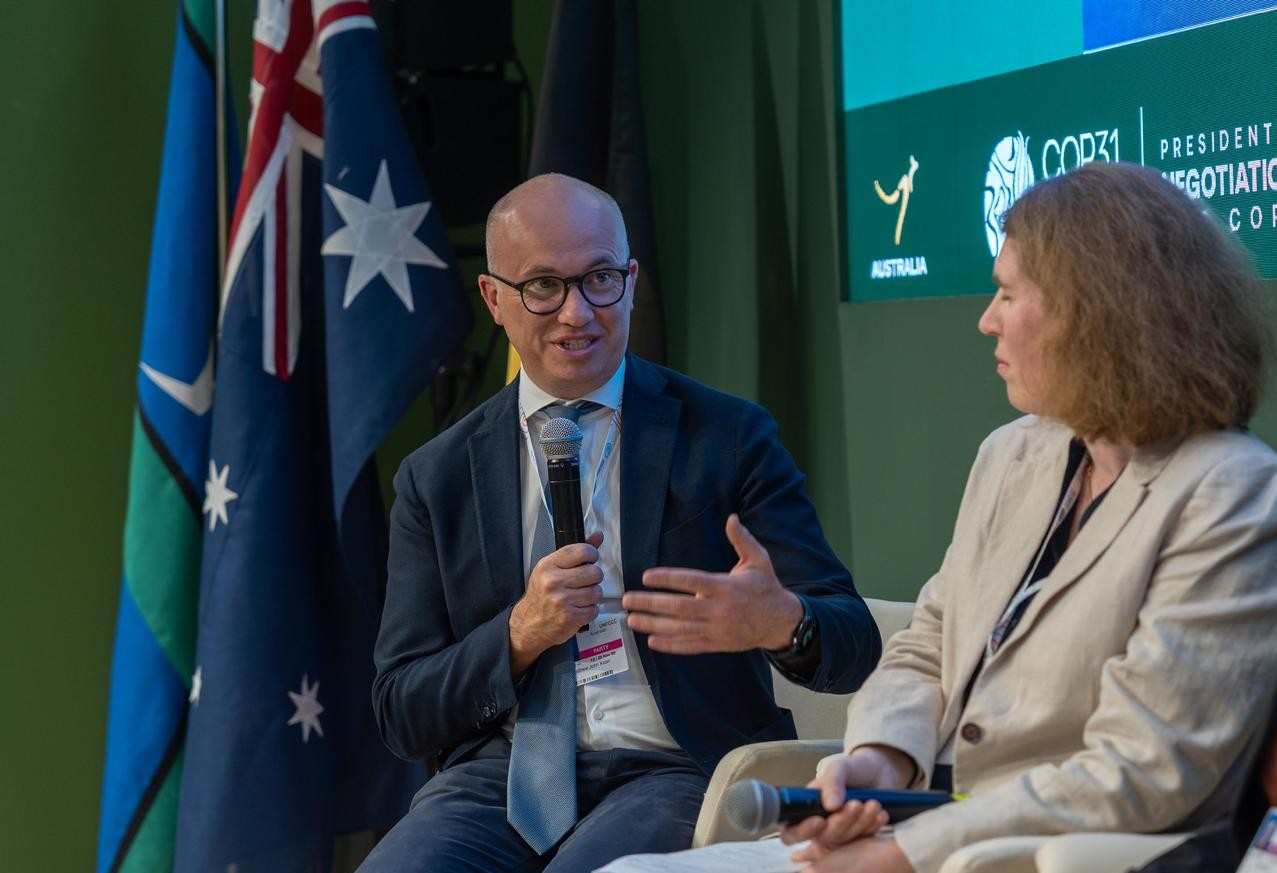
Live speech - COP31 Australia Pavilion
The Hon. Matt Kean
Chair - Climate Change Authority
Check against delivery.
We gather here at COP31 at a troubling moment.
At precisely the time the world needs stronger action on climate change, the politics in many countries appear to be moving in the opposite direction. Political divisions are deepening. Climate commitments are being challenged. Yet the consequences of a warming planet are becoming increasingly difficult to ignore.
We have seen devastating floods in Nepal, with communities losing lives, homes and livelihoods. And across the Himalayas, rising temperatures are creating profound risks for communities already vulnerable to natural disasters.
The science tells us that every fraction of a degree of warming matters. And every year of delay matters.
But there is another side to this story.
Renewable energy is growing at extraordinary speed. Clean technologies are becoming increasingly competitive. And the economics of energy and industry are changing. The International Energy Agency expects global clean energy investment to reach around US$2.2 trillion this year.
So, we face something of a paradox.
At the very moment the politics of climate action is becoming more difficult, the economic foundations of the transition are becoming stronger. And that tells us something important.
Climate action is not simply an obligation. It is an opportunity to build stronger economies, more secure industries and a more prosperous future.
Nowhere is that opportunity more significant for Australia than in our relationships with the great industrial economies of Asia.
For generations, Australia has built its prosperity by supplying the world with the resources it needs.
Our iron ore helped build the great cities and industries of Asia.
Our coal and gas helped power their economic development.
And our relationships with Japan and Korea became some of the most important economic partnerships in Australia’s history.
But the world is changing. And so are our customers. The countries that bought our resources to build the industrial economies of the twentieth century are now investing in the technologies and industries that will define the twenty-first.
Consider South Korea, one of Australia’s most important trading partners, and one of the world’s great industrial economies.
Korea has announced a green transformation program involving approximately $1.1 trillion AUD in planned public expenditure and climate finance over the next decade. It has set a target of 100 gigawatts of renewable energy capacity by 2030. And it is pursuing the transformation of industries including steel, manufacturing and transport.
Japan is undertaking its own industrial transformation.
These are our customers. These are our trading partners. And these are the industries that have underpinned Australian prosperity for generations.
Japan has invested deeply in Australia over many decades.
Korea is an enormously important trading partner, but there is considerable scope to deepen its direct industrial investment. And that points to an opportunity beyond simply selling a different set of commodities.
The next chapter should be about moving from trade to shared investment, shared industrial capability and shared economic security.
Australia has abundant renewable energy resources, vast mineral wealth, skilled workers and established relationships with the industrial economies of our region. But our greatest advantage may be something less tangible:
Trust.
For decades, our trading partners have relied on Australia to supply the materials and energy underpinning their economic security. Now we can deepen those relationships by becoming more integrated into the supply chains driving their future growth.
We should want Japanese and Korean companies to see Australia’s industrial success as fundamental to their own.
… Their steelmakers investing in Australian green iron.
… Their manufacturers securing long-term supplies of Australian critical minerals.
… Their banks and institutional investors financing the infrastructure that makes those industries possible
… And their technology companies working alongside Australian businesses.
Think about what that could mean.
Australian renewable energy could help transform Australian iron ore into low-emissions iron.
That iron could be shipped to Korea or Japan and transformed into steel.
That steel could become the vehicles, machinery and infrastructure that power our economies.
And those commercial relationships could create decades of investment, employment and shared prosperity.
We would no longer simply be selling resources into our customers’ supply chains. We would be helping build those supply chains together. But there is something even more important.
These partnerships would not simply help Australia decarbonise. They would help the world decarbonise. Because emissions do not respect national borders.
If Australia can help a Korean steelmaker replace emissions-intensive inputs with cleaner Australian materials, the climate benefits extend well beyond our shores.
If our renewable energy and resources help Japanese manufacturers produce lower-emissions products, we contribute to the transformation of global industry.
And if these commercial models succeed, they can be replicated across other industries and trading relationships.
By helping our trading partners reduce their emissions, we can build our own prosperity while contributing to the global task of reducing emissions. But this will not happen automatically. Having the resources, technology and ambition is not enough. We need to turn economic potential into investable projects.
And this is where the international conversation needs to change. We have become very good at signing agreements. Agreements on hydrogen, critical minerals, clean energy and industrial decarbonisation. These are important foundations. But an agreement between governments does not automatically create a project that a bank can finance.
An Australian producer needs confidence that someone will buy its product at a price that supports investment.
An industrial customer needs confidence that reliable, affordable low-emissions materials will be available.
And investors need to understand the risks and how those risks will be managed.
The challenge is not simply finding capital. It is creating the commercial conditions that allow capital to move. That means coordinating long-term purchasing commitments, project finance, export credit and appropriate risk-sharing arrangements. It means aligning standards so that low-emissions products made in Australia can be recognised and valued in international markets. And it means bringing together the different parts of a supply chain so that investment decisions reinforce one another.
Consider green iron. An Australian producer may need a long-term contract from a Japanese or Korean steelmaker. That steelmaker may need confidence its customers will pay for lower-emissions steel. And financiers may need certainty about technology, infrastructure and future revenues. Each party may be waiting for the others to move. Governments working together can help break that deadlock.
This is why the Climate Change Authority has released From agreements to assets. Our proposition is straightforward. We need to move from expressing ambition to delivering investment. Identify the value chains where countries have complementary strengths. Bring governments, industrial customers, developers and financiers together. Identify the barriers holding back investment. And work systematically to overcome them. Not with another declaration of intent. But with commercially credible projects capable of reaching final investment decision.
That is the real measure of progress. Not how many agreements we sign. But how many projects get financed. How many facilities get built. And how much economic value and emissions reduction we deliver.
I want to finish where I started.
We are meeting at a time when the world needs stronger climate action, even as the politics becomes more difficult. We cannot lose sight of the human consequences of inaction. But neither should we lose sight of the extraordinary economic opportunities before us. We do not have to choose between building prosperity and protecting the planet.
For Australia, the opportunity is to make them part of the same economic transformation.
… To build industries that create jobs and investment at home.
… To deepen the economic relationships that have served us so well.
… To strengthen our shared economic security.
... And to help our trading partners, and the world, reduce emissions.
Previous generations built the trading relationships that transformed Australia’s economic fortunes. Our generation has the opportunity to build the relationships that will shape the next century.
I want Australia to be a country that doesn’t just supply the world with what it needs today, but helps create what the world will need tomorrow.
That is why we must move from agreements to assets. Because the future will not be determined by the promises we make at conferences like this. It will be determined by the investments we make, the industries we build and the emissions we reduce.
With that, I’ll throw to Kath and the esteemed panel.
Thank you.