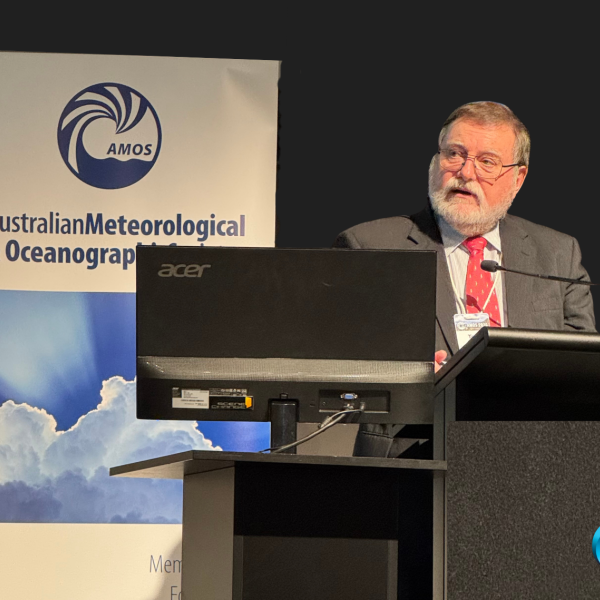

Catastrophe and Reinsurance Symposium keynote speech
The Hon. Matt Kean
Chair - Climate Change Authority
Check against delivery.
May I begin by acknowledging the Guringal people, the traditional owners and custodians of the land where we gather.
I’d like to pay my respects to elders, past, present and emerging, and extend that respect to any First Nations people here with us today
It’s a real pleasure to address this year’s Catastrophe and Reinsurance Symposium just a couple of days after some pretty heavy overnight downpours across this region of Sydney.
And there’s tropical cyclone Narelle in the process of crossing the far north Queensland coast during this speech, potentially as a severe category 5 storm.
I won’t be offended if some of you keep a wary eye on your phones – but if the bulk of you start looking fixated elsewhere I might get worried!
As it happens, it’s very timely for us to be exploring the role of public scientific organisations, particularly in Australia.
Some of you may know the Climate Change Authority last month held a roundtable of key government agencies and departments, scientists and end-users in Canberra to examine how climate science and modelling is faring in Australia.
More on that later.
Many of you will also be aware that our premier public scientific agency, the Commonwealth Scientific and Industrial Research Organisation, or CSIRO, is currently consulting on changes to its research portfolio.
So today I want to detail 2 examples of how public science supports research in the national – indeed international – interest.
Others can point to health or even quantum batteries but I’ll stick with climate.
Let me start with the more obscure of the 2 case studies as the effects of Narelle may become clearer the longer the address goes on, making it harder for me to keep your attention.
Scientific discovery can often be taken for granted, but things we observe and understand now were once not known or misunderstood.
Then along came some smart person or team, who conducted an experiment or joined a few data dots that others hadn’t done before.
Many of us have some notion of the ozone hole over Antarctica, and the human-made chemicals that destroyed the ozone layer.
You might also know that ozone serves as a protective shield screening out about 98% of the sun’s medium-frequency ultraviolet radiation.
Without it, we’d get sunburnt after a few minutes of exposure, crops would wilt, phytoplankton would die, and so on.
You might also know we went from discovery of the ozone hole – by the publicly-funded British Antarctic Survey – in 1985, to signing the Montreal Protocol to combat the use of ozone-eating CFC chemicals, in just 2 years.
Foundational science made that ozone hole detection possible and then informed governments of the consequences and they acted.
It’ll take another 4 or 5 decades for the hole to be closed if current policies remain in place but at least we’re headed in the right direction, according to the United Nations (UNEP, 2023).
It’s tempting to reflect on our global failure – so far – to make sizable cuts in greenhouse gas emissions even though the science of global warming is unassailable.
We can, though, point to progress in lowering the emissions trajectory.
The war in the Middle East has lately given us an energy security imperative to wean ourselves off fossil fuels to add to the climate one.
I raised the ozone example, though, to underscore that we humans are conducting a giant experiment on our biosphere and the consequences of what we’re doing might not be fully evident.
Scientists are our sentinels, providing early warnings about risks that might seem obscure and prove to be minimal or turn out to be a much bigger problem.
Now to the obscure bit.
Let’s say there’s a molecule that helps break down methane and other non-carbon-dioxide gases in the atmosphere.
And let’s say that without that molecule, those heat-trapping gases hang around longer and will warm up our atmosphere yet more, exacerbating all the climate change effects that you in this audience are already trying to insure against or mitigate.
And let’s say this molecule disappears about a second after doing its job.
Wouldn’t you like to know how that molecule is going – is there as much up there as before the industrial revolution, say – and how would we go about finding out?
That helpful scrubber’s name is hydroxyl, which involves a single hydrogen atom bonding to an oxygen atom.
Hands up who in here has ever heard of hydroxyl?
Not so many.
And who but public-good science would ever embark on a mission of discovery about such a radical?
CSIRO, as it happens, led by a senior researcher, David Etheridge, working with a team that included scientists from the Universities of Washington and Rochester in the US backed up by Australia’s Antarctic science division.
The project has been underway since 2018, and involved drilling ice cores at least 240 metres deep in Antarctica’s Law Dome and they’re looking to drill in Greenland, too (before it changes hands?).
Why dig up ancient ice?
Well, they are looking for a proxy molecule – the carbon-14 isotope of monoxide – and all that accumulated snow at Law Dome has protected carbon-14 levels from cosmic ray going back centuries.
I won’t spoil the final research results – you'll have to read about it after Dr Etheridge’s peers have finished their review, likely later this year.
But they will inform us whether hydroxyls are keeping up with all the scrubbing of methane and other greenhouse gases that we’ve been asking of them.
Perhaps we’re doing fine – or perhaps we’re going to find out that the warming we’re inflicting on the planet is actually going to accelerate even on present emissions levels.
Obscure but important work, I’d argue and I think you’d agree.
Phew, still with me?
Let me give a more straightforward example of the contribution of public science...one that my dear friend and fellow member of the Authority, Australia’s Chief Scientist Tony Haymet recently discussed at a scientists’ gathering in Hobart.
I should note that Tony, a former senior CSIRO oceanographer himself, also has more than a few shrewd insights about the value of supporting research in the national interest.
This second example is also about Antarctica because what happens in the extreme south can have a big influence on weather over Australia...even in normally benign and balmy places like Manly.
That remoteness is important to underline because it's not easy – or cheap – work to do.
To get accurate readings of polar vortexes, ice-shelf melting, sea-ice movements, and so forth, you need a sophisticated array of satellites, sea- and ice-based instruments, and a lot of brave souls who don’t mind the cold!
And, as Australia can’t do it all alone, we need to work in concert with many partners including, you guessed it, public scientific organisations.
Some of you might remember researchers and weather forecasters – here and abroad – getting excited last September by an unexpected event taking place some 40 kilometres above the icy continent.
The usually frigid polar vortex was observed to be heating up to about 35 degrees Celsius above normal in what’s dubbed a sudden stratospheric warming.
In the Northern Hemisphere, such events happen about every other year over the North Pole, but they are quite rare over Antarctica.
Sudden stratospheric warming matters to us because these events can influence extreme weather in the mid-latitudes – that is, where we and most Australians live.
And that indeed is what Australia witnessed in the months after last September.
The seasonal forecast issued by the Bureau of Meteorology – another vital public organisation – switched from favouring the odds for a wet spring, as is more typical in a La Nina year, to a drier outlook.
Stronger westerly winds likely added to drought conditions in southern Australia, primed the bush to burn, and increased the likelihood of the record-breaking heatwaves that we endured across parts of southeastern Australia in January.
Farmers, firefighters and regional communities were among those with a visceral stake in detecting phenomena such as stratospheric warming events.
I would add insurers and re-insurers to that list.
How might these warming events change in a hotter world? I think Australians have a stake in knowing.
Who is going to provide that information?
Perhaps the private sector could marshal the components – from satellites to surface-based sensors – but what would they charge us? Would they be transparent and accountable?
Beyond the detection and warning about sudden shifts in the stratosphere, communities are going to want to know more generally how wilder weather in a hotter world is going to affect them.
How will their health, housing, jobs and the wider economy be impacted by climate change?
We do have some guidance, such as from the first National Climate Risk Assessment.
That report, released last year, drew on research from publicly-supported science but also commercial entities such as insurers.
As broad and comprehensive that assessment is – and I commend it to your reading lists if you haven’t scoured it yet – the report noted some key knowledge gaps.
(The authority has recommended we do such assessments regularly to help close those gaps.)
The report, though, didn’t anticipate the terrible oceanic algal blooms that have been bedevilling the South Australian coast amid marine heatwaves, and other disturbances to the natural order.
Nature is going to throw up surprises, not all of them pleasant ones.
In any case, understanding how rainfall will change over Australia as the climate warms up would be of great interest to farmers, to households and to businesses, such as infrastructure managers and, yes, insurers.
Andy Hogg, the head of ACCESS-NRI, the publicly-funded science organisation that helps develop our key weather models, knows a bit about knowledge gaps.
He told the Senate inquiry last week that the global climate model ensembles we tap into cannot – yet – tell us whether rainfall in our biggest food bowl, the Murray Darling Basin, will go up or down as the planet heats up.
Professor Hogg says one reason is that our rainfall depends largely on what’s going on in the Southern Ocean and the Pacific.
The climate modelling nations are mostly in the northern hemisphere – and they tend to focus, naturally, on oceans nearer them.
In a call to support funding for CSIRO – which feeds ACCESS-NRI – Professor Hogg said that if we’re not prepared to fund modelling here, it will be harder to make the advances in prediction we need to be able to, say, forecast whether we’re facing a drier – or wetter – Murray Darling Basin.
Or perhaps we’ll get more rain when it falls, and longer droughts in between.
Incidentally, the Government is due to conduct its decadal review of the Basin Plan this year and will have to advise on potential climate change impacts.
It was in the spirit of such challenges that the Climate Change Authority convened a roundtable on climate science and modelling last month in Canberra, as I mentioned at the start of this address.
Developing and maintaining Australia’s world-class expertise in climate science is very much in our national interest.
It is needed, for example, to know whether we should strengthen or extend our cyclone construction codes in our tropical regions something we had advocated in our Home safe report in the wake of Cyclone Alfred last year.
That billion-dollar storm might have been much more costly had it maintained a track that at one stage had it landing much closer to Brisbane and the highly populated regions of southeast Queensland and northern NSW.
We’re going to spend many billions, perhaps trillions of dollars in the decades ahead to lift the resilience of our communities, and to repair those hard-hit by wild weather.
Wouldn’t we be wiser if we were able to narrow the range of risks so that we adapt rather than mal-adapt in a warmer world?
Gaining that sort of expertise would not only give us a competitive edge, by the way, but it would be of interest to our neighbours and partners in the Pacific and elsewhere.
Gathering and storing that climate intelligence is, of course, of little use if we don’t have adequate super computers and storage to hold such data.
And having such information is not much use if such data is not carefully modelled and analysed, and accessible to the people who need it.
Needless to say, there are a few interested parties in this room.
The roundtable, we hope, raised the salient points not just among those invited but for a range of relevant ministries, too.
Our newsfeeds tell us every morning that there are many claims on the attention of our policymakers at all levels of government.
I hope today’s address has helped provide some insights into why public science matters...and that Narelle hasn’t diverted your attention too much either!
Happy to take your questions and thanks for listening!
Further reading