
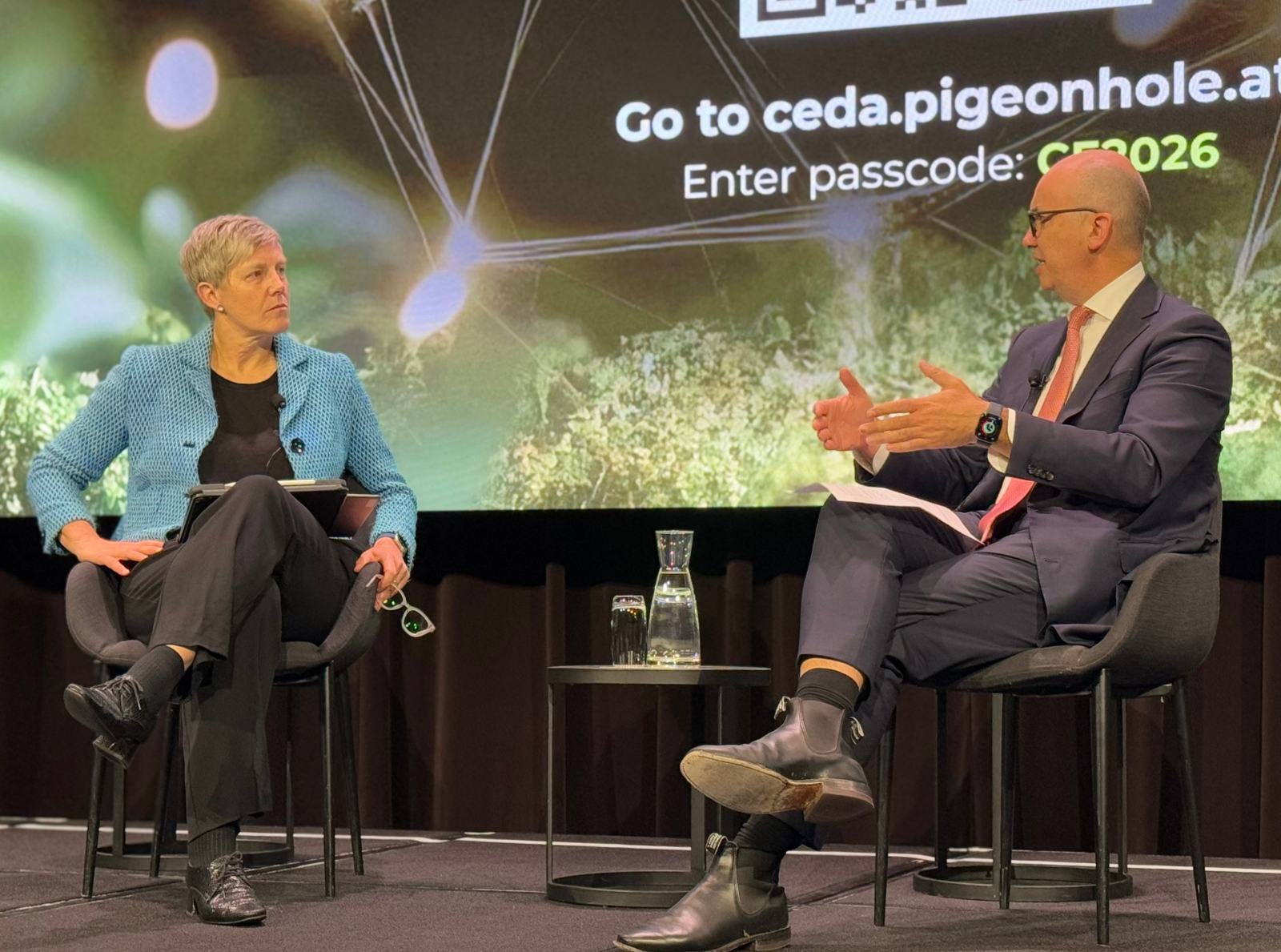
CEDA Climate and Energy Summit
The Hon. Matt Kean
Chair - Climate Change Authority
Check against delivery.
May I begin by acknowledging the Wurundjeri Woi-wurrung people of the Kulin Nation as the traditional owners of the lands we meet on today, and pay my respects to their elders, past and present.
It’s an honour to address this Climate and Energy Summit on behalf of the Climate Change Authority. Thanks to CEDA for the invitation, and for assembling so many great speakers for this timely event.
Back in mid-February when I accepted this invitation to speak, I had planned to highlight how shifting to clean energy and away from fossil fuels would bring cost savings for households and businesses, alike.
Decarbonisation, in other words, is good for the planet but also increasingly good for our finances.
Indeed, nature’s blessings of abundant sunshine and wind above, and a treasure trove of critical minerals below, gift Australia the pole position in this transition race.
The war in the Middle East, in revealing our fossil fuel vulnerabilities, fortifies every link in the logic chain that I was going to lay out for you.
It gives me no comfort whatsoever that the pain being experienced at the bowser by motorists every day, nor the anxiety farmers face in securing needed fertiliser, is adding to the economic case to decarbonise.
Amid the market shocks, it is even more important that we make the right calls when it comes to delivering real energy – and climate – security for Australians.
Some of the recent reactions, such as a push to open up new oil and gas fields, are – at a gut level – perhaps understandable.
But we shouldn’t let these market disruptions push us down costly cul-de-sacs that won’t lower energy costs. If we do, they will add to the economic and emission burdens future generations won’t thank us for.
Where you and I – and probably every energy minister in our region – see this oil and gas crisis as a clarion call to cut our dependency on these volatile commodities, some – including vested interests – would have us increase that exposure.
Australia’s energy security can be enhanced by boosting output of homegrown electrons – rather than importing or prospecting for more fossil molecules – and the technology to do that is already being rolled out at scale.
But before I explore those issues, let’s remind ourselves about the climate challenges we face, whatever happens in the Strait of Hormuz.
As a former Treasurer of NSW, I had a front-row seat in tallying up the costs of disasters being made worse by our warming world.
That vantage point included having to rally funding for the 2022 floods in northern NSW that cost billions of dollars, and were part of the third-most costly extreme weather event in the nation, according to the Insurance Council of Australia(Opens in a new tab/window).
The bouts of floods across northern Australia in recent months will no doubt need costly rebuilding and restocking. Remote First Nations’ communities, in particular, are finding life that bit harder.
High-intensity rainfall events are becoming more common in Australia(Opens in a new tab/window) and elsewhere in the world(Opens in a new tab/window).
Basic physics tells us that each degree celsius of global warming allows our atmosphere to hold about an extra 7% more moisture.
And we have clocked up about 1.44 °C(Opens in a new tab/window) of warming, versus the 1850-1900 average, by the end of 2025.
Northern Australia, of course, also has to cope with tropical cyclones.
As the Climate Change Authority noted last year, scientists predict a greater proportion of cyclones will reach severe strength because of the warmer atmosphere and oceans. That means category 3, or stronger, tempests.
Last month, many of us were captivated by the path of tropical cyclone Narelle. It became only the second system since reliable cyclonic records began(Opens in a new tab/window) in 1980 to make landfall three separate times at severe category strength.
Parts of Queensland, the Northern Territory, and Western Australia have got some reconstruction work to do thanks to cyclone Narelle, a burden not made easier by any bump in fuel costs or any shortages.
Lastly, as many of you know, the past three years were the three hottest years, globally, on record.
2026 will almost certainly be placed in the top five, especially if – as seems increasingly likely – an El Niño event takes hold in the Pacific.
El Niños tend to increase the odds of a drier than usual winter and spring(Opens in a new tab/window) across Australia's eastern states.
In other words, drought and elevated fire risks may compete with the Middle East for news headlines and our attention before too long.
Let’s hope these early forecasts are wrong!
So, we now have energy security competing with the imperatives to act on climate change.
In some ways, we’ve been here before.
A quick scan of Trove will reveal that the first Iran-related energy scare, back in the late 1970s, threw up schemes to convert coal-to-oil.
There was even a plan to develop Queensland’s Taroom Basin’s oil reserves, a region lately back in the news.
An obvious point is that those projects didn’t proceed back then.
The economics are likely to be even more formidable today, not least because we have far more competitive clean-tech options – and they are getting more competitive every year.
And that’s without taking into account the climate and other environmental issues – such as water access – that should temper enthusiasm about developing new, high-cost fossil fuels in remote regions.
In any case, projects that will take years, perhaps even a decade, to build won’t address any near-term energy constraints.
So let’s look at the cleaner, cheaper alternatives that are ready and raring to go right now.
For starters, a solar farm can be built in two years or less, a big battery plant even sooner.
A wind farm typically takes longer but it's another scalable technology that – along with solar and storage – tends to become more efficient and cheaper with each doubling of output.
Last year, we saw estimates that about two-thirds(Opens in a new tab/window) of the investment in new energy sources globally in 2025 would be in non-fossil fuel sources, according to the International Energy Agency.
Indeed, renewable energy overtook coal power globally last year for the first time, according to Ember,(Opens in a new tab/window) a consultancy.
In Australia, too, we have seen renewables eclipse coal and gas in our main power grids(Opens in a new tab/window) – again, for the first time – at the end of 2025.
Australian households, of course, have been pioneers in the take-up of roof top solar. More than 4 million homes, or about 40%, have solar panels.
The Government’s Cheaper Home Battery scheme has seen more about 350,000 households also invest in batteries since last July, alone.
And with reports that the efficiency of solar panels could be improved by another third(Opens in a new tab/window), thanks in part to advances made in Australian labs, you can start to see why the sky is, literally, the limit for renewables.
Similarly important developments are evident on our roads, too.
In the Climate Change Authority’s advice to government on Australia’s 2035 emissions targets, we scoped out various paths to reach 62 to 70% below 2005 levels.
These included the prospect that half of all cars sold over the next decade could be electric vehicles.
Let me tease that out in a simple thought experiment, to reveal the enduring fuel security benefits.
If Australia were to build a new conventional refinery, it would likely take the better part of a decade to deliver and, on indicative figures, add petrol output equivalent to only a modest share – around one-sixth – of national demand.
By contrast, if half of all new cars sold over the next 10 years were electric – which is one of the plausible pathways we examined – that would steadily and permanently cut demand for imported oil.
Over the decade, the reduction in liquid fuel demand would be material; by the end of the period, the cut could be of the order of one-third of annual petrol demand.
That is not a complete answer to every liquid fuel challenge, particularly for agricultural and industrial users of diesel, as well as freight and aviation.
But it would mean that, year after year, more of our transport task is being powered by Australian electricity rather than imported oil. That is what enduring resilience looks like.
One consequence of the soaring fuel prices is that drivers can’t fail to notice them when they pass any service station.
Not surprisingly there has been a big jump in interest lately in electric vehicles and hybrids.
Whether that interest ebbs or surges hinges on how developments in the Middle East play out, and that’s anybody’s guess at this point.
But what can’t be denied is that EVs are becoming more competitive over time given the in-built energy efficiency of electrons over what we describe – for now – as conventionally powered vehicles.
We don’t need to wait for batteries offering a 1500-kilometre range for a six-minute charge(Opens in a new tab/window) that are now in prospect in China – but more leaps like that for EVs can be expected.
Yes, there are some who might hold out for a vehicle that can drive from Melbourne to Sydney and back on one charge, but we can’t please everybody all at once!
The point is that the cost of running an EV versus a petrol or diesel – powered one was already lower before the Iran war. That edge will be sharpened, the longer fossil fuel prices remain elevated.
The cost of buying a new EV was already on track to match alternative models within a year or two.
Many buyers, particularly if they have solar energy at home, or the on-site means of charging an EV, may now place a higher value of energy security than previously.
The national New Vehicle Efficiency Standard paved the way for an increase in the EV model selection available to Australians.
Governments at all levels are smoothing the EV adoption path further by building more public charging locations, and some are even providing apartment blocks incentives to wire-up for future charging needs.
This shift is not limited to our cars. In industries like mining, electric dump trucks are being introduced and Fortescue is even commissioning electric(Opens in a new tab/window) locomotives that can recover as much as 60% of their energy through carting iron ore downhill – saving around a million litres of diesel every year.
That’s about half-way to being a perpetual-motion machine, such are the wonders of battery storage with a little help from gravity!
This also raises a broader policy question.
As electrified and hybrid options start to become viable in parts of mining and other diesel-intensive industries, governments will need to examine whether existing diesel tax settings are aligned with the resilience and productivity gains we want to encourage.
Public support should do as much as possible to help bring forward genuine fuel-switching and productivity gains, rather than underwriting business as usual.
Not everybody can switch to an EV, and some may not want to. That’s fine, and governments can play some useful roles here, too.
Low-carbon liquid fuels are an option. We’ve seen that Queensland has lately invested $25 million(Opens in a new tab/window) to help produce renewable diesel at the Lytton refinery – one example of how existing fuel infrastructure can be adapted for lower-carbon alternatives – and more such ventures will likely attract investors.
Similarly, sustainable aviation fuel may also prove more competitive than previously anticipated.
Australia’s relatively abundant land and farming expertise already positioned the country to be a supplier of sustainable aviation fuel (SAF), as it’s known, before the latest geopolitical gyrations.
There is another opportunity emerging at that same Lytton refinery. A proposed Brisbane Renewable Fuels project could produce sustainable aviation fuel at a scale that is genuinely material to domestic demand.
For aviation – one of the harder sectors to decarbonise – that is exactly the sort of capability we should be trying to bring forward. But these projects do not just appear because they make sense on paper.
They need enough policy certainty, early enough, for investment decisions to be made, feedstocks to be secured, and domestic supply chains to take shape here in Australia.
So if governments are thinking about where new fuel capability and policy certainty are most valuable, there is a strong case for prioritising the lower-carbon fuels we will need in harder-to-abate sectors, rather than trying to recreate more of the old fossil system.
Australian innovation can play an important role in other relatively hard-to-replace liquid fuel markets too.
While electric trucks may be grabbing large shares of the market already in places like China and parts of Europe, Australia’s long-distance road freight will probably take longer to electrify.
Nascent technology from companies such as VE Motion(Opens in a new tab/window) based in Murray Bridge, South Australia, may offer competitive, near-term answers.
They’re building and testing hybrid systems that pair diesel-powered prime movers with electric motors on the axles of the trailer.
According to co-founder and CEO Dean Panos, Australia builds 30% of the prime movers on our roads, but up to 95% of the trailers.
Their devices can HALVE diesel use and improve truck performance, much like EV cars typically offer owners a superior drive over standard varieties.
Before the latest Middle East war, Panos estimated the payback for the investment would be 3 to 5 years. Should diesel prices stay where they are, the payback period is more like 18 months to 2 years, he says.
The company predicts 100s of trucks will be fitted with their devices in a couple of years, but if the Australian Design Rules approval can be shortened – without any safety corners being cut – the take-up could be in the thousands, and sooner.
Noting transport has been the fastest source of carbon emissions growth, actions that help flatten and reduce truck emissions would have added health and environmental benefits. This switch would also improve the balance sheets of truckies across the nation.
Diesel has been one of the fuels in notably short-supply in regional Australia, and it’s not just used for hauling freight.
About 3% of diesel is used in Australia goes to generate electricity, mostly at remote mines that are off the grid, and in Indigenous communities.
The spread of low-cost solar and batteries – including solar farms that can be dismantled when the ores run out at a particular mine site – will increasingly reduce demand for that diesel.
That will spare the fuel for other uses, such as farming. That industry, too, is finding that innovations, such as the spread of solar-powered water pumps, reduce if not eliminate the need for diesel.
The high cost of diesel and petrol – and concerns about potential future rationing or supply interruptions – will no doubt spur other inventions and create new markets for nimble entrepreneurs.
That’s why we should take heart from the progress being made across a range of low- or zero-carbon industries.
And let’s not forget that stable policy matters, not just for the consumers and businesses trying to make their best choices, but also for investors like many of you in this room today.
After all, the fastest, most efficient route between two locations is rarely – if ever – via zig-zags and the proverbial U-turn!
As Treasury noted(Opens in a new tab/window) last September, a disorderly transition off fossil fuels would be far more costly for the economy than an orderly one.
An orderly course reduces cost-of-living pressures via lower wholesale electricity prices, and enhances Australia’s renewables export potential.
And so, to conclude, the convulsions in commodity prices in recent months only underscore our national interest in remaining on the decarbonisation course.
The UK’s Climate Change Committee, our equivalent in London, found(Opens in a new tab/window) that the total additional cost of a single fossil fuel spike of the magnitude of 2022’s crisis precipitated by Russia’s illegal invasion of Ukraine was as large as the entire combined cost of meeting that country’s pathway to net zero.
The current crisis shows every sign of causing a much bigger blow to the UK economy – and who would wager on this one being the last such fossil-fuelled shock?
Our destination hasn’t changed, but excuses for delay get less and less credible.
Shifting economics are transforming what had seemed niche technology to become necessary and compelling clean energy options to compulsory ones.
Add all that up, and the incremental can become the exponential for the benefit of our economy and the environment alike – and the future generations of Australians to come!
Thanks for listening.
Further reading