Welcome to this fortnight's edition of On Good Authority. We highlight how renewables are strengthening Australia’s energy security amid geopolitical tensions, and the US’ move to plug-in solar. We have some good news about Australia’s continued fall in emissions and how protected cropping is helping safeguard Australia’s food production. New analysis also shows gas prices—not renewables—are the main driver of rising power bills, and we look at a new First Nations guide on equity in clean energy projects.
Our members have been talking about the energy transition, climate science and more over the past fortnight:
3 March – Chair Matt Kean gave a keynote speech at the Suits to Wilmot event near Armidale. In his speech Matt noted the benefits that decarbonisation can deliver to regional Australia and the agriculture sector.
9 March – Chair Matt Kean was among speakers at the opening day for Climate Action Week Sydney(Opens in a new tab/window), which includes a series of community-led events designed to elevate NSW's contribution to global climate action.
25 February – Chair Matt Kean spoke at the Nature Conservation Council NSW Business Breakfast, emphasising the urgency of climate action and the role of clean technologies and clear targets in driving Australia’s transition.
Households are becoming central participants in Australia’s energy transformation. With the right regulatory framework and ongoing innovation, electrification,…
International Association of Horticultural Producers keynote speech
The Hon. Matt Kean Chair - Climate Change Authority
Check against delivery.
Introduction
May I begin by acknowledging the traditional owners of the land where we meet today, the Gadigal people of the Eora Nation.
I’d like to pay my respects to elders, past, present and emerging, and extend that respect to any First Nations people here with us today.
And I want to thank the International Association of Horticultural Producers for the honour of speaking with you today.
As an organisation with a global focus - and with many of you representing growers and producers - you’re acutely attuned to dynamics shaping the debate on climate change and its implications.
The carbon clock is ticking.
The timeline for delivering on international commitments to curb temperature rises looms large.
And threats to the natural environment we all depend on are obvious.
Something well understood in the horticulture sector.
The health of the planet touches every aspect of your industry
. . . yield and quality, irrigation and energy costs, biosecurity risk, access to export markets and consumer expectations.
It makes climate policy core business for agriculture.
And it’s why today I want to outline the link between challenges facing your industry, the work of the Climate Change Authority, and opportunities for you to prosper in a low-carbon world.
Pressures on horticulture
Any debate about any aspect of climate policy needs to start with an honest assessment of the state of play.
Globally, food security is under stress from a changing climate.
Rising temperatures, a drier planet, and a growing list of extreme events are already reducing yields of key staples.
In a world where more than 295 million people across 53 countries and territories already face acute hunger, the risks are compounding.
Official forecasts estimate climate change could push 78 million more people into chronic hunger.
The Intergovernmental Panel on Climate Change (known better as the IPCC) suggests that number could be higher.
And the impacts aren’t just on farm.
There will be disruption to transport corridors, storage and cold-chains and even food safety.
The prospect of greater volatility across supply chains and trade-exposed industries like horticulture are high.
The story is no different at home.
In recent decades, some of Australia’s most productive farming districts, such as the south-west and south-east, have been battered by climate change.
They have witnessed a long-term decline in rainfall, matched with record temperatures and extended droughts.
Heatwaves damage fruit set and quality.
Extreme storms, hail and fires impact orchards and infrastructure.
Pest and disease ranges shift with warming.
And the very physiology and nutrition of plants and crops change in response to higher average temperatures and rising atmospheric carbon dioxide levels.
These are real business risks, not abstract science.
That was reinforced by the Australian Government's recent release of its first National Climate Risk Assessment.
It determined the current risk level for primary industries and food to be medium to high, noting the impacts of extreme heat and shifting rainfall patterns on soil moisture and crop yields.
The Assessment also identified water insecurity as a major, long-term concern for some regional communities.
And it made clear that the threat to farm incomes is real.
These risks escalate in scenarios where we fail to respond swiftly or boldly.
But here’s the flip side.
If we’re willing to understand that acting on climate change is both an environmental imperative and an economic one too, we can prosper.
Global demand will increasingly favour suppliers who can produce reliably under climate stress and demonstrate strong sustainability credentials.
Horticulture—nutrient-dense, high-value, quality-driven—can be a pillar of global nutrition and resilience, and Australia is well placed to lead the way with our endless capacity for innovation.
The work of the Climate Change Authority
That’s where the Climate Change Authority, which I’m privileged to Chair, comes into play.
For those new to our work, the Climate Change Authority provides independent, evidence-based advice to the Australian Government.
We do it through advice on emissions reduction targets, the pathways to achieving them and annual progress reporting.
We also conduct policy reviews such as the Australian Carbon Credit Unit Scheme review currently underway.
In short, our job is to help steer Australia to a prosperous, resilient, decarbonised future
. . . and that includes working with sectors like horticulture, not prescribing from afar.
Most of you will be aware of the emission targets that Australia has set for itself
. . . a 43 per cent reduction on 2005 levels by 2030
. . . a 62-70 per cent cut by 2035
. . . and net zero by 2050.
Sustaining the Australian success story
The Government’s commitment to the new 2035 target recommended by the Authority matters for a few reasons.
It matters because it is a consequence of a rigorous process of assessing a host of issues ranging from the environmental pressures we face, to international trends, to sector-by-sector opportunities.
We looked at the economics of decarbonisation and capital trends, explored technological advancements, consulted widely and relied on expertise.
It means the targets are credible and achievable.
They are also bold.
Even at the low end of the range, they require that we halve Australia’s current emissions in the coming decade.
They will deliver Australia some of the largest emissions cuts anywhere in the world.
They will help Australia retain its position as a global pacesetter in the race to net zero.
With policy, markets and technology now aligned, industry has greater comfort to allocate capital and make investments in the transformational solutions we need.
And the good news is that the decarbonisation of the Australian economy is well underway.
Technology is already driving a profound shift in our carbon profile.
It’s been most obvious in our electricity grid, where renewables accounted for half of all generation in the final quarter of 2025.
And for producers and farmers, the adoption of onsite solar, batteries and electric pumps can cut bills, reduce emissions and lift resilience to grid disruptions.
But achieving net zero was never just about energy-based solutions, as crucial as they are.
It requires a whole-of-economy effort, where our success with methane abatement or carbon sequestration will matter just as much as what we achieve across the grid.
Opportunities for horticulture to prosper
That’s why we want to lean into the opportunity to convert what are real risks to your business into momentum and solutions that help us create a more productive and prosperous horticulture sector.
The Authority’s 2025 progress advice places equal emphasis on resilience—ensuring regions, businesses and communities can thrive as conditions change.
This includes smarter infrastructure, robust finance, and clear policy to crowd-in private investment.
The National Statement on Climate Change and Agriculture frames it well: climate-smart practice should enhance productivity and profitability while building resilience and lowering emissions in partnership with industry.
That is especially resonant for horticulture, where margins are tight and consumer quality demands are exacting.
The electrification of vehicle fleets will eventually extend to farming too, as automakers launch more hybrid and fully electric ute models and even tractors. Owners will enjoy lower maintenance and operating costs, particularly if they generate their own energy, as so many farmers already do.
There are two other opportunities in particular that I want to highlight, as they both deliver durable carbon outcomes alongside on-farm agronomic benefits.
The first is biochar.
Biochar is a carbon-rich material produced by heating organic matter such as prunings, crop residues, or manures in a low-oxygen environment.
When applied to soil, its stable, porous structure can store carbon for hundreds of years and influence nutrient and water dynamics.
It represents a durable carbon sink and in some instances, reduces nitrous oxide emissions from soils.
Biochar can also be produced from food and green waste. This diverts organics from landfill, cutting methane emissions as well as enriching soils.
Recent reviews of Australia’s food-waste-to-biochar potential underscore this dual benefit for climate and soil.
Trials and in-field experience has shown it can increase the availability of water for plants by 20-30 per cent in certain soil conditions.
It improves nutrient retention and microbial activity, and above all, stabilises performance under heat or moisture stress.
These benefits are tailor-made for orchards, vineyards, berries, protected cropping and high-value vegetable systems.
There is still some work to be done to understand how it responds to specific sites and applies to particular products, but it’s enormously encouraging.
The other opportunity is what’s known as enhanced rock weathering, or ERW.
It’s a natural process that can be accelerated and managed by applying finely crushed silicate rocks, most commonly basalt, to soils.
Through chemical reactions with atmospheric CO₂ and water, carbon is locked into stable, solid carbonates, offering a durable carbon storage solution.
Growers can use existing spreading equipment, which is a big advantage for adoption.
ERW can improve soil pH, nutrient retention, and water-holding capacity, with studies reporting positive yield and soil function responses in some systems.
It is already attracting corporate attention and public R&D support globally, and monitoring, reporting and verification methods continue to evolve, informed by research and trials(Opens in a new tab/window) being done by Australia’s science agency, the CSIRO.
It’s now an emerging opportunity that looks to prove its effectiveness as more trials occur and research partnerships are built, which underlines the promise to the sector
. . . that is, when we have faith in the capacity for farmers to embrace science, innovate and pursue new ideas, we can build a more resilient future.
It’ll require extensive collaboration between growers, businesses, industry bodies, research institutes, governments and yes, the Climate Change Authority to propel action.
I’m confident in our capacity for smart, bold action in driving the new practices, technologies and solutions we need.
Conclusion
By embracing these opportunities, we can ensure that the horticulture sector remains a strong, vibrant part of Australia’s economic future.
That’s because there’s no need for horticulture to be left stranded by the risks of a changing climate.
Acting now can both reduce the industry’s emissions footprint and fortify the industry’s prospects in the face of a changing climate.
So let’s seize the chance to give Australian horticulture a competitive edge in a decarbonised world where it is productive, profitable and climate-positive.
It’s all within reach, and I look forward to working with you to make it happen.
The Hon. Matt Kean Chair - Climate Change Authority
Check against delivery.
May I begin by acknowledging the Gumbaynggirr people as the traditional owners of the land where we meet today.
I’d like to pay my respects to elders, past, present and emerging, and extend that respect to any First Nations people here with us today.
It’s great to be visiting this beautiful part of the planet – can I thank the teams at Impact Ag Australia and Wilmot Cattle Co for extending me an invitation, and accommodating my late changes.
I’d like to frame today’s discussion, if I may, mostly in positive terms. Decarbonisation, handled well, can deliver lasting benefits to regional Australia in general, and to the agriculture sector, specifically.
Farm incomes can be boosted and diversified, ecology above and below the surface can be enhanced, and communities that have long contributed to the spirit and dynamism of Australia can be made more resilient.
I should add at this point that our hosts, Alasdair MacLeod and his Macdoch Ag Group, don’t need any prodding from me.
Wilmot farm demonstrates that well-managed grazing makes great economic and environmental sense.
Innovation and tenacity often come with the territory when it comes to farming in Australia – I’m sure you’ll have been impressed by seeing what your team, led by Kierin Wilson and Shane Curtis, has achieved.
Wilmot and Macdoch have recognised – as have scientists for some decades – that farmers are going to have to adapt to a changing climate faster than many other parts of our society.
Droughts and flooding rains are indeed a feature of this beautiful nation, as Dorothea Mackellar evoked in her famous “My country” poem, composed more than 120 years ago.
The issue for those who live off the land, however, is that those droughts and floods are intensifying and becoming more frequent.
After all, each degree of global warming enables the atmosphere to hold about 7% more moisture, so the potential for heavier downpours when they do happen is well-established in the science.
And in between those bouts of rainfalls, it’s also possible that heatwaves may also become more severe.
In other words, depending on how weather patterns shift, those on the farm might have to build in resilience both ways – for both wetter AND drier times, as counter-intuitive as that combination might seem.
For Wilmot, one approach, I understand, is to reduce the relative share of exposed ground, compared with more conventional farming methods on nearby properties.
Improved soils and biodiversity are just 2 of the benefits, as Kierin and Shane may have talked you through the strategies already.
The exposure of weather-dependent industries – such as farming – to climate change was detailed at length in the National Climate Risk Assessment, released by the Government last year.
That Assessment, the first done for Australia, examined many of the perils facing the country, with climate risks for agriculture featuring prominently, especially around water security.
The report noted, though, the risks extend well beyond the farm gate. Of course, city dwellers are going to notice if supply disruptions result in higher prices for their food and fibre.
But rural communities reliant on nature-based businesses may well face more acute stresses, particularly where regions are reliant on only a few industries for economic activity.
That’s just one reason why diversification of revenue sources is one way to bolster resilience in trying times.
As I’ll detail shortly, Australia’s decarbonisation efforts offer our regions additional ways to keep farms viable, whatever the weather headed their way.
As the Risk Assessment report noted, major disasters can trigger longer-term challenges. It noted, for instance, that the Millenium Drought caused 6,000 job losses at its peak, while the Black Summer bushfires cost about 7,000.
Retaining workers – or luring them back – after such events is not easy.
Again, building businesses and industries that have staying power can limit the exodus of skilled staff that can be hard to lure back even when conditions settle.
I should add that statistics don’t always count what’s important. Communities know, and authorities are getting better at recognising, there are often mental health impacts in the wake of disasters that need to be anticipated and addressed, as part of the recovery efforts.
It’s something I came to understand in the aftermath of record floods in the Lismore region when I served as Treasurer of this state.
The courage, particularly of volunteers during these emergencies, gave me hope the foundations of those communities were strong. But they also steeled my determination to do what I could to reduce the risks of climate change.
As I noted in a recent opinion piece after the bad bushfires in Victoria in January, we in fact owe it to those selfless individuals, who put their own well-being and often their own properties on the line for others, to be upfront about the changes we need to make.
So, I return to the central theme of this discussion: building resilience is not only good for farm productivity, it’s also good for the viability of our rural communities.
As I noted in a recent edition of the Farm Policy Journal – perhaps you had it on your summer reading list – farmers rightly have been proud of their long-standing roles in supplying vital services like food and fibre.
I argued that their services will increasingly be supplemented by new but also essential ones – from supporting our energy transition to aiding biodiversity and capturing carbon. And they should take pride in them too.
Together, this range of services, old and new, can combine to future-proof our regional communities for generations to come.
Curbing carbon emissions is in everybody’s interest, especially farmers’, given they already occupy the frontlines in a more volatile climate.
And there is a financial interest in sequestering carbon that is already being realised by many farmers and investors in this sector.
It’s probably not well understood how much a role the land sector is already playing in helping Australia meet its greenhouse gas emissions targets.
Renewable energy’s advance draws a lot of media attention – both well- and ill-informed – because the power sector is the largest source of carbon emissions in the economy.
But as the Government’s latest Greenhouse Gas Inventory numbers(Opens in a new tab/window) reminded us just last week, emissions from land use, land use change, and forestry have decreased by the largest margin of any sector since June 2005 – shaving off more than 150 million tonnes of carbon dioxide (or CO2)-equivalent annually since then.
That drop is because of reductions in land clearing and native forest harvesting, increases in plantations and native vegetation, and improvements in land management including soil carbon on agricultural lands.
By contrast, emissions from the power sector have shrunk about a quarter since 2005, paring annual emissions by about 49 million tonnes of CO2-equivalent. That’s about one-third as much as the land sector, as broadly defined.
In giving our advice to the Government for Australia’s 2035 emissions targets last year, the Climate Change Authority provided illustrative examples of where carbon cuts can come from in the decade to come from 2026.
We do see the land sector becoming a slightly larger annual carbon sink than it has been over the past two decades.
The bulk of the expected additional cuts, though, will likely come from the electricity sector in the order of more than 100 million tonnes of CO2 reduced from annual pollution levels.
In other words, the reduction efforts secured through the land sector since 2005 will increasingly need to be taken up by other parts of the economy.
Incidentally, emissions from Australian agriculture itself – our livestock and cropping – have been broadly flat over the past couple of decades.
As the inventory report noted, these emissions are down about 5 million tonnes of CO2-e, or about 5.7%, since mid-2005. Most of that reduction is because of a decline in the sheep herd, partly offset by higher emissions from agricultural soils and fertiliser use.
Stacked side by side, agriculture and land-sector changes are of a similar magnitude in terms of emissions.
In the year to September, agriculture-sourced emissions amounted about 18.5% of Australia’s total, while these so-called “Lulu-C-F" emissions were the equivalent of minus 16.6%.
It makes sense to reduce emissions directly as much as possible and as soon as possible. This approach minimises the need for carbon removals and the knock-on impacts on energy supply, water, and other land uses. However, the Climate Change Authority’s analysis indicates Australia is likely to have residual emissions in 2050, which will need to be balanced with removals – this is the “net” in “net zero”, after all.
And as I mentioned earlier, we anticipate such removals to continue to play a significant role in Australia's transition, perhaps growing to more than 100 million tonnes of CO2-e by 2050.
Still, given agriculture accounts for almost one-fifth of our nation’s emissions, it is important to unlock further progress in cutting them.
We are not banking on major reductions in the near term from this sector – but the more Wilmot’s practices get mimicked elsewhere, the better.
In this context, I’m thinking of better herd and pasture management, and planting improved pastures, among other measures.
As we noted in our 2035 targets advice, there are multiple research projects underway to examine opportunities and practices to sequester carbon on perennial pastures and cropping land.
We can expect, too, advances in technologies that address methane emissions from cattle and sheep, and reduced emissions from fertiliser, while we also recognise such efforts are in relatively early stages of deployment.
While there is scope to modify feed additives to curb those methane burps from livestock, you can imagine the delivery challenges facing relative free-range farms such as Wilmot.
Just how to get those methane-inhibiting supplements out to where the cows, sheep and even buffalo roam? (Assuming there’s a market for bison varieties.)
Researchers and agricultural producers are working on that now – with government support – and the solutions they find could make a material contribution to emission reductions in the longer term.
Other technological advances are on the way.
Electric vehicles now available include electric utes, which will probably only improve in range, power and price.
Perhaps the relative silence of these vehicles will also appeal to hunters frustrated by the roar of a complaining diesel engine scaring-off potential game.
Farmers are famously self-reliant too, and what can be more DIY than powering your own appliances, even tractors, from the sun?
There’s usually ample room to add solar panel arrays – and you can save a long round-trip into town or a visit from a diesel tanker.
Whatever it takes to win the bush over to clean energy – I'm for it!
Now, another source of emissions reduction involving the land is of course via the Australian Carbon Credit Unit Scheme.
This area is of interest to at least a few of the organisations attending today’s sessions.
I believe at least 3 of you have made submissions to the ACCU review now being undertaken by the Climate Change Authority.
We welcome your contributions.
The Authority is mandated to conduct a review every 3-years – and this one is the first to occur since I became Chair about 18 months ago.
The Authority is presently working through the results of our public consultation period that closed on 8 December.
This review will take into account the context of recent developments, such as Australia’s 2035 target.
We’ll also consider the 2023 reforms to the Safeguard Mechanism, which have seen the main purchaser of ACCUs shift from the government to liable Safeguard entities.
As we have stated, the review will work to answer the question of whether the ACCU Scheme is correctly calibrated to deliver sufficient abatement to meet the needs of a decarbonising economy.
Our recommendations to the government may include how the scheme’s operations can be improved, how public confidence in the scheme can be supported, and what more can be done to ensure it helps Australia achieve its emissions reduction goals.
So, we covered the reason why we need to cut our emissions, and explored some of the ways regional Australia is already benefitting from and assisting this necessary transition.
There’s obviously a lot more work to do but also nearly boundless opportunity for those who act, particularly if they move quickly.
We do have agency when it comes to determining our futures – whether you make your living on the land or generate investment returns from it.
Let’s make the most of these opportunities!
Thanks again for the invitation to address you. I’ll be happy to entertain your questions here or later on.
As well as our news in brief, this edition we take a closer look at the Climate Science and Modelling Roundtable convened by the Climate Change Authority on 13 February. The event brought together leading climate science agencies, senior policymakers and major climate data users to address growing concerns about the resilience of Australia’s climate intelligence system.
We’re refreshing this newsletter to make it more useful with less noise, but still giving readers the climate news you love. You’ll now receive OGA every fortnight on a Wednesday and back issues will be available on our website. Please email us at oga@cca.gov.au to let us know what you think of the new OGA.
Australia’s Chief Scientist urges stronger climate intelligence, better computing infrastructure, and bold communication to protect the nation from rising…
Australia’s 62–70% emissions reduction target by 2035 is not just a climate goal but a once‑in‑a‑generation economic transformation — one that hinges on…
The Authority convened a national roundtable of leading science agencies, policymakers and data users to look at the growing risks to Australia’s climate…
Nature Conservation Council NSW Business breakfast
The Hon. Matt Kean Chair - Climate Change Authority
Check against delivery.
May I begin by acknowledging the traditional owners of the land where we meet today, the Gadigal people of the Eora Nation.
I’d like to pay my respects to elders, past, present and emerging and especially to any who might be here today.
It’s a pleasure to back here today – can it really be 5-years since the last shared appearance at an NCC Business breakfast?
Back then I was the Energy and Environment Minister for his state, and Minister Bowen held the shadow portfolio of Climate Change and Energy… one of us has lost more hair than the other.
Some things haven’t changed much. Back then, I spoke of “green becoming mainstream”, with growing pressure on business to demonstrate a “credible path to lower emissions”.
I nominated the delivery of cheap, clean energy into the supply chain for every business in NSW as “an urgent priority”.
Sounds familiar? Those comments were true 5 years ago – and given the fact we have had the 3 hottest ever years – 2024, which was ahead of 2023 and last year – the climate urgency is just as great, if not greater.
Now I could steal some of the Minister’s thunder by detailing the records being set in renewable energy and storage that are evidence of the building momentum – but that would be a tad ungracious on my part.
In any case, businesses are increasingly required to disclose their climate-related risks and opportunities, as they should.
We already have firms that meet at least 2 of the following criteria: more than 500 employees, and gross assets of more than $1 billion or annual revenue exceeding $500 million making such disclosures. And from this July, those thresholds will drop by about half.
There is some onus on all of us to consider what we’re doing to reduce our carbon emissions for the sake of our children and the glorious Australian environment we’re so lucky to enjoy. But the good news is that we already have access to a range of technologies that enable us to lower pollution while also cutting costs.
As consumers, an array of devices from heat pumps to solar panels to electric vehicles provide clean ways to power our lives. The same is true for many business processes too, giving owners greater control than ever before over how they source and use energy.
Sometimes, there’s a need for governments to nudge businesses and investors to act. At other times, policymakers can make the space or reinforce the signals that markets need for capital to move.
Those signals include setting clear emissions reduction goals, which Australia now has, in the form of our targets for 2030 and 2035, on the way to net zero by 2050. The Climate Change Authority last year provided the advice for those 2035 targets: to cut 2005-level emissions by 62-70%. And I can report that the Government graciously accepted it.
As energy and environment minister here in NSW I was fortunate to have willing collaborators across the political aisle when it came to some of the biggest energy and climate debates. I’m pleased to observe that 5 years on, most of those policies remain in place even though the state government changed hands (not the result I wanted, mind you!).
Now, the Authority is apolitical, so I won’t comment on the contrasting circumstances facing Minister Bowen. Yet more thunder I’ve left unplundered for him!
What I will say, though, is that the lack of bipartisan support for big matters such as climate action is regrettable.
Could we have responded to big challenges, such as fighting world wars or even COVID-19, as effectively if one or more large party in opposition had actively opposed such action?
The same goes for the decarbonisation of our economy, and that of the world’s.
We have an acute interest in the success of this transition…including the businesses represented here today…with Australia particularly exposed both to the downside risks of a hotter planet AND the upside opportunities with our abundant renewable and mineral resources. If we get this right.
Australia’s Chief Scientist urges stronger climate intelligence, better computing infrastructure, and bold communication to protect the nation from rising…
Australia’s 62–70% emissions reduction target by 2035 is not just a climate goal but a once‑in‑a‑generation economic transformation — one that hinges on…
The Authority’s fourth Annual Progress Report finds that Australia is accelerating emissions reduction, but more is needed to meet our targets and adaptation…
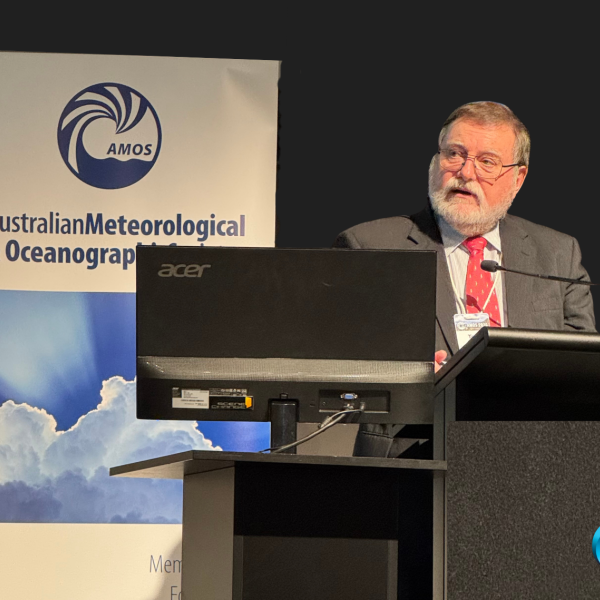
2026 Australian Meteorological and Oceanographic Society Conference keynote speech
Prof. Tony Haymet Chief Scientist
Always nice to be back in Nipaluna (Hobart) and to acknowledge the Traditional Owners – the Muwinina people – and pay my respects to their Elders past and present.
About 23 years ago, I worked here in Hobart as chief of CSIRO’s Marine Research, then Marine and Atmospheric Research.
May I also give my thanks to AMOS for inviting me to speak at a second consecutive summit, and this time kindly offering me a much less rowdy venue than my evening appearance last year at a craft brewery in Cairns.
I’m always excited to learn about the advances of your members’ work, even if the tidings are not always good ones.
I’m here today wearing two hats... in my role as Australia’s Chief Scientist and also as a member of the Climate Change Authority, representing its Chair, Matt Kean.
Matt convened an important climate science and modelling roundtable in Canberra last Friday... more on that later...
First let me describe a tale of scientific advancement. It’s one that underscores the importance of your work to all Australians and the great necessity for ongoing research. It’s also a tale that shows how important it is to find ways to communicate scientific findings to the public and to policymakers.
Last September, Australian researchers and weather forecasters – some of you here today - would have watched on with a mix of awe and interest as an unexpected event was taking place some 40 kilometres above Antarctica.
The usually frigid polar vortex was heating up to about 35 degrees Celsius above normal in what’s dubbed a sudden stratospheric warming.
I am told such events happen about every two years over the North Pole, but they are quite rare over the icy continent. Sudden stratospheric warming is linked to extreme mid-latitude weather, and that’s what Australia witnessed in subsequent months on this occasion. The Bureau of Meteorology’s seasonal forecast – previously favouring the odds for a wet spring in a La Nina year – shifted to a drier outlook.
Stronger westerly winds then added to drought conditions in southern Australia, primed the bush to burn, and increased the likelihood of the record-breaking heatwaves that we endured in January. Farmers, firefighters and regional communities are among those with a visceral stake in detecting phenomena such as stratospheric warming events.
And in fact, we should all want to know how climate change will affect these events in the future because the impacts will be so wide-ranging... affecting all Australians – their health, their housing, their jobs, their communities. Marine heatwaves are already fuelling destructive algal blooms, bleaching our coral reefs, supercharging storms, and threatening coastal eco-systems that have sustained communities and industries for generations.
***
That we could detect this sudden stratospheric warming over a remote part of the world at all is an illustration of how far science has advanced in recent decades. Measurements made at Australia’s Macquarie Island and Davis Station in Antarctica played a vital role, as did satellites observing changes in atmospheric ozone.
The processing and modelling of that data at home and abroad underscore how we rely on a global network for our weather and climate predictions.
This intricate climate intelligence eco-system is not one we can take for granted. We must make plans, and back-up plans, to ensure this eco-system is sustained and enhanced. By doing so, we can help protect Australian families and industries from the worst impacts of climate change.
With that in mind, Matt Kean, the chair of the Climate Change Authority, convened the special climate science and modelling roundtable last Friday in Canberra.
While I was unable to attend due to a prior ministerial engagement, I know the roundtable brought together senior officials and researchers from across our science-to-service supply chain.
We had people well-versed in the science, the data, the climate modelling, the infrastructure of super computing, and a range of end-users from the public and private sectors.
***
I mentioned the sudden stratospheric warming event – and its impact on Australian weather – because it’s one of many climate examples that are both a warning and an opportunity.
They highlight the pervasive impact of climate change and, at the same time, they remind us that we must maintain and enhance our capacity to observe the planet.
They remind us of the ongoing need to collect, process and understand the data … the need to improve our predictive models … and the need to convey the information to the many potential users.
***
Climate intelligence is significant national infrastructure that your work directly contributes to. Enormous progress has been made in climate science but there is far to go, and there will be far-reaching implications.
The data that you gather, and work with, contributes not just to climate modelling, but to decisions that can improve our economy, agriculture and health outcomes, defence planning and disaster preparedness. As such, climate data is an enabling asset across society, government and the economy.
I echo the view of our chair, Matt Kean, that you can’t have good economic modelling without a good approximation of the risks of global warming, depending on how emissions play out.
I won’t say much more about the roundtable ... there are other speakers here today who were at the gathering, and I don’t want to steal their thunder. But I do want to touch on one topic it discussed that will be of interest to many of you: high-performance computing and data, and its role in climate science.
I’m pleased to inform you that Australia’s high-performance computing and data needs are currently being examined by the nation’s top science advisory body to the Prime Minister.
The Minister for Science has asked the National Science and Technology Council to provide advice on Australia’s future research needs in this area.
Incidentally, I understand there’s a workshop at this conference focussing on developing a National High Performance Computing and Data Roadmap for Climate Science in Australia.
Now, you don’t need a supercomputer to know there’s a lot to take into account when considering what the high-performance computing and data landscape could and should look like in the coming decade.
I'm not here today to pre-empt the council's advice. But I do want to briefly spotlight some of the key questions and issues that are shaping conversations about this technology.
Recent discussions in Australia’s scientific community raise legitimate concerns about whether our digital infrastructure in this area can keep pace with existing and projected demand.
There are concerns about infrastructure that is fragmented, ageing, or not structured for emerging needs in some areas.
These are healthy discussions that help to clarify issues by raising questions about the allocation of resources.
At a global level, the benchmark for computing capability continues to rise.
Countries and regions – including Europe, Japan, China, the USA and Singapore – are making large investments in high-performance computing.
But this does not mean Australia should simply match their spending.
Like all nations, Australia has finite budget resources. The question is not whether to invest in this technology, but how to make strategic, pragmatic, clear-eyed choices that maximise the benefits to our nation.
You work in scientific disciplines defined by data. And as our computing power grows, our data capability must grow with it. If our data storage capacity lags behind our computing power, this can create bottlenecks that undermine research.
In a country as big as Australia, we must also carefully consider questions about connectivity and the location of our facilities.
We are a large nation with dispersed infrastructure and very large data-sets, particularly in areas like climate, astronomy and resources.
When it comes to the marriage of supercomputing and data facilities, co-locating them can be an important consideration. It can reduce the cost and difficulty of massive data transfers and can reduce latency in computer processing.
On the other hand, high-speed, high-volume networks can also be deployed to efficiently connect data storage to computing systems.
And in some cases, it’s a matter of bringing the computing system to the data storage location – rather than the other way around.
***
Regardless of how the data is stored and managed, that data is the very bedrock of climate science and the scientific information that enriches our nation.
But in 2026 Australia faces a rising tide of misinformation dressed as science.
Artificial intelligence and social media are turbo-charging its spread. I know many of you are concerned about that, and I want to touch briefly on it today.
Australia’s top science advisory body to the Prime Minister – the National Science and Technology Council I mentioned earlier – has commissioned landmark reports on misinformation.
They show we can be vulnerable to it because of the way our brains are wired. Research finds humans are naturally inclined to believe new information – especially if it’s simple, familiar, or comes from people we trust. The more we see it, the more credible it seems, even if it’s false.
Poor physical or mental health can also reduce cognitive capacity, increasing susceptibility to falsehoods.
These falsehoods are a global challenge – especially so in science. And your work, and your data, can be part of a global response to addressing this challenge and combating misinformation.
***
I would like to conclude with some final observations about the value of climate science for Australia, and how we might best act on the knowledge you generate.
Your work has never been more important – because, sadly, Australia now finds itself in hot water. And that’s not a metaphor. It’s the scientific reality of our rapidly warming oceans.
The climate crisis is reshaping life across the nation, from our oceans to our insurance premiums, and it’s going to get worse both in Australia and across the world. But we can avoid the harshest impacts by making deep global emissions cuts. Australia has great scientists – like you – and is a wealthy country with the resources to address these challenges.
Reducing emissions, tonne by tonne, is the most effective way to meet our climate targets.
At the same time, we must foster the work of those in the climate sciences. And strive to ensure your discoveries – about sudden stratospheric warming, for example – are brought to widespread public attention. By doing so, your work can inform Australia’s decisions across all levels of government, businesses and society more broadly.
So, I encourage you to be bold in your science, and perhaps bolder in the communication of your important findings.
The Hon. Matt Kean Chair - Climate Change Authority
May I begin by acknowledging the traditional owners, the Wurundjeri Woi-wurrung and Boon Wurrung peoples of the Kulin Nation.
It’s a privilege to be here at the Climate Investor Forum — because if we are serious about Australia’s emissions targets, then we need to be serious about the role of capital.
And today I want to answer a very practical question: How do we turn Australia’s climate ambition into investable opportunity?
Because Australia’s 62–70% emissions reduction target by 2035 versus 2005 levels is not simply a policy objective — it's an economic transformation agenda.
And it will succeed or fail on one thing above all: our ability to mobilise capital at speed and at scale.
Now, if you look back a quarter-century to how we lived in 2001 and compare that with 2026, you could argue that a lot has changed.
Our houses are a bit bigger, and Australia’s has added an extra Victoria in population terms, or more than 7 million people.
More than a third of our houses generate our own electricity and one in six new cars sold last month was an electric vehicle (EV) — compared with a virtual absence of such gadgets back then.
Indeed, last quarter, renewable energy supplied more than half the electricity in Australia’s main grid for the first time.
Such advances, though, will seem quaintly slow over the decades to come as technology advances, particularly around electrification, make “turbo-charging” seem sedate.
And when we look overseas, we can see what’s possible. In China, the leader in so many of the clean fields, sold 13.3 million EVs domestically last. Easily the world’s largest auto market by units, more than half of sales were electric.
In electricity generation, the stats are even more eye-popping. While Australia added in the order of 10 gigawatts of new solar and wind capacity in 2025, China added that amount about every 9 days... clocking up 430GW, or more than the rest of the world combined, according to Carbon Brief(Opens in a new tab/window).
So, what might our world look like in 2050 (coincidentally also a Year of the Horse in the Chinese Zodiac, matching the Lunar New Year that began just yesterday)?
There are many reasons to think we are experiencing a new industrial revolution, guided by artificial intelligence, which will need lots of energy.
Australia, with some of the best renewable energy resources on the planet, will have a commercial and even geopolitical edge over other regions.
Steel, aluminium, ammonia, silicon...whatever you forge, the fuel will increasingly be green.
And while there will be sectors which still need to burn fossil fuels and require a response to climate change, there is hope in what this could look like, too.
Those with hectares to spare will discover new ways to derive income. In addition to traditional agriculture, we could see landowners using carbon sequestration methodologies to bolster soil health, reduce erosion, provide shading for livestock and reduce the drying of our landscape. Hosting solar and wind farms will be more common, too.
And rewilding of biodiversity-rich corridors can reverse the slide of our remarkable and unique Australian ecology – aiding landowners in the process.
Together these efforts can enable us to prosper unlike any previous generation but do so in ways that don’t cook our atmosphere and acidify our oceans, avoid melting the giant icesheets of Antarctic and Greenland and so, spare our current coastlines from rapid sea-level rise, among other benefits.
And it will be with private capital, in particular, that we can realise this potential.
1. The world has changed
We are living through a profound global economic reset.
The net zero transition is no longer just about climate risk. It is now about:
industrial competitiveness
supply chain security
energy sovereignty
and economic leadership.
According to Boston Consulting Group’s analysis, meeting Australia’s 2035 ambition requires roughly $475 to $630 billion of capital investment over the next decade.
That’s in the order of $1 billion — per week.
There will be a lot of competition for that money.
Yes, the Trump administration has been busy winding back the previous government’s Inflation Reduction Act, but a lot of the allocated billions will still be spent as the Act intended.
And many US states are pressing on with their decarbonising goals, so it’s not just California dreaming.
Elsewhere, the impetus for decarbonising is still intact, whether it’s in Europe with their Green Deal Industrial Plan, China – as mentioned — show little sign of reigning in its gigantic investments in renewables and storage.
Other parts of Asia, the Middle East and beyond will vie for capital to meet Paris Climate commitments – and to stay competitive.
In other words, Australia must keep itself an attractive destination for global funds. We are NOT guaranteed a podium placement even with all our natural advantages.
Yes, we all need to cut carbon emissions. The good news is that these efforts are fast becoming the dynamos of economic activity.
More than a third of the growth of China – the world’s second-biggest economy — was generated by the clean energy sector in 2025, according to Carbon Brief(Opens in a new tab/window).
To be clear, global capital isn’t holding out for perfect certainty.
After all, expanding firms are typically disruptors of the status quo.
We must position ourselves to be magnets for private capital — including from our own superannuation funds that often preference investments in renewable energy and other clean-industry target outside Australia, rather than those at home.
Jurisdictions seeking to lure and retain that capital will be more likely to succeed if they can offer:
credible targets,
stable policy frameworks,
investable project pipelines
and execution capability.
Much is at stake. If Australia wants to have a say in this global shake-up, we can’t be merely price-takers of others’ technology and innovation…not if we want to generate well-paying jobs in sustainable industries.
2. The scale of Australia’s task
Australia’s 62–70% emissions reduction target by 2035 is ambitious. On a per-capita basis, the cut is 76%-81% from 2005 levels – among the steepest reductions on the planet.
It requires a step-change in our efforts to date.
True, we have already made meaningful gains in decarbonising the grid, opening the way to hammer emissions lower as large swathes of the economy electrify.
But it is important to state clearly: the next decade will need to see more progress than the last one.
Capping and then cutting emissions has to happen in several areas, such as:
transport fuels
methane
and hard-to-abate industrial activity, including cement, steel and agriculture.
In other words, the future won’t just be about closing coal-fired generators.
3. Why this is not a cost story — it’s an opportunity story
When we talk about the transition, too often the conversation is framed as a burden.
But the evidence is increasingly clear: the net cost of the transition is manageable, and the investment opportunity is enormous.
Decarbonisation requires major capital deployment in electricity generation, storage, transmission, distribution, and electrification.
The costs may loom large, but not all of the expenses should be considered “extra” – rather consumer as usual.
The Climate Change Authority, for instance, drew up one pathway towards meeting the 2035 emissions goal that envisaged half of all cars being sold from now until that year being EVs.
That wasn’t a prescription nor prediction, to be clear.
But the point is that Australians would be snapping up new cars as the vehicles aged anyway, and their replacements will feasibly be electric in about half the purchases.
Energy efficiency will often be a built-in feature of this transformation.
Some industrial processes — think cement and steel-making — will need further innovations to be competitive.
Heat pumps can shift the heating and cooling loads to the grid. A range of other industrial activities can also be electrified for lower operational costs than gas even with existing technology.
In any case, if that’s where the consumers are headed, suppliers will want to be there.
Follow the money, to be sure, but smart investors are those who anticipate where that money is headed and get there first.
By the way, those benefits extend beyond savings for consumers and lower carbon emissions.
This change is also about:
energy security
productivity
industrial competitiveness
and what “A Future Made in Australia” should look like.
And we shouldn’t just aim for clean-tech assembly. Rather, the design and building of scalable, exportable systems are what we want.
4. Australia’s strategic advantage
Australia has the potential to be a critical player in the evolving global economy.
Not because we have the biggest population or the biggest manufacturing base, obviously.
But because we have structural advantages that few countries can match.
Aside from abundant low-cost renewable resources and a periodic table’s worth of critical minerals, we have engineering capability, deep institutional expertise, and one of the largest pools of long-duration capital in the world through superannuation.
Legislated targets also mark a strong national direction of travel.
That gives Australia an opportunity not just to decarbonise domestically, but to build new export and industrial platforms.
Because, as I said at the outset: the global economy is not only decarbonising — it is reindustrialising.
And the competitive advantage in a net zero world is simple: cheap, clean, reliable energy.
If Australia can deliver that, we can become an industrial powerhouse in green commodities. Apart from those I’ve already mentioned, sustainable fuels and clean manufacturing supply chains will round out our offering of high-value, clean industrial products to world markets.
5. The real constraint: capital mobilisation
But to realise that opportunity, we need to be honest about the binding constraint.
The constraint is not technology.
The constraint is not ambition.
The constraint is capital mobilisation — and the conditions under which private capital is willing to deploy.
Investors don’t invest in targets.
They invest in cashflows.
They invest in risk-adjusted returns.
And for investors, the question is: can Australia translate ambition into investable opportunity at scale?
That requires 3 things:
policy durability
credible price signals
execution capability.
If those elements are weak, the cost of capital rises, projects stall, and investment is delayed or diverted to more compelling markets.
If those elements are strong, capital competes to enter.
6. Policy settings and price signals to crowd-in capital
So, what does it take to mobilise private capital at scale?
In my view, five things matter. First, stable long-term targets with near-term milestones. Targets must extend beyond electoral cycles. Investors need confidence that direction will not reverse.
Second, credible and durable price signals. The economy needs a clear signal that emissions will carry an increasing cost over time. That doesn’t necessarily mean a single economy-wide carbon tax. But it does mean credible constraints and mechanisms that affect behaviour and investment.
The Safeguard Mechanism is an important step in that direction.
And the stronger and more predictable the signal, the lower the risk premium investors will demand (a government review of the mechanism in 2026-27 should reinforce that signal).
Third, investable revenue frameworks. The transition is not held back by a lack of capital. It is held back by a lack of bankable projects.
Mechanisms like underwriting, long-term contracting, and credible offtake arrangements are essential to crowd-in private capital.
Investors will fund renewables, storage, and electrification infrastructure at scale if revenue certainty exists.
Fourth, clear priority sector strategy. Australia needs to focus on where abatement is achievable at scale and at least cost.
The core pathway is clear:
decarbonise electricity
electrify transport and industry
reduce methane
and scale high-integrity sequestration
Policy should reinforce this least-cost pathway.
Fifth, execution reform — planning, approvals, and delivery. Execution risk is fast becoming the binding constraint.
Delays in approvals and transmission delivery are increasing project risk and raising the cost of capital.
This issue is not confined to climate action.
It is economic reform.
If Australia wants to attract global capital, we must become faster, more coordinated, and more predictable in project delivery.
7. Where the capital must go
If we look at the real economy, the capital deployment priorities are clear.
The transition will be won or lost in four areas:
1. Electricity generation and storage — scaling renewables and firming capacity is foundational.
2. Transmission and distribution - the grid is the platform for the whole economy. Without transmission, generation cannot connect, and electrification cannot scale.
3. Transport electrification — transport fuels are now one of the largest emissions sources. EV uptake and charging infrastructure will be decisive.
4. Methane and removals - methane is a large share of emissions, and it is often lower-cost to abate than many industrial solutions. Removals will also be necessary — but they must be high-integrity and durable.
These are not theoretical sectors.
These are investable sectors today.
8. Structuring co-investment to crowd-in private capital
So how do we accelerate deployment?
Government cannot fund this transition alone.
And it shouldn’t.
The goal is not to replace private capital.
The goal is to use government strategically to unlock private capital.
That means designing structures that share risk appropriately.
Some of the most effective models include:
Public-private co-investment - Government takes early-stage risk; private capital scales.
Blended finance vehicles - where government provides first-loss or concessional capital to reduce risk premiums.
Aggregation platforms - pooling smaller assets — like EV charging, distributed energy, and industrial retrofits — into institutional-scale investment vehicles. This is how we are going to fund the missing middle – those sectors of the economy which need to decarbonise, but which are too capital intensive for venture and too nascent to be infrastructure.
Long-term contracting and offtake underwriting - providing revenue floors that reduce merchant volatility.
Industrial precinct models - where enabling infrastructure — transmission, firming, ports, shared services — is coordinat-ed to reduce cost per project.
These are not abstract ideas.
They are proven global models.
And they are precisely the kind of structures that institutional capital responds to.
9. Why private capital should deploy now
For investors, there is a strong case for deployment now.
Because the transition is producing scarcity value.
Grid connection and firming are becoming scarce.
Transmission corridors are scarce.
Permitted, bankable projects are scarce.
That means early movers are not just supporting the transition — they are positioning themselves in the highest-demand part of the value chain.
Second, electrification is driving structural demand growth.
This is not a cyclical story. It is a multi-decade growth story.
Third, global policy momentum is not going away.
Markets will evolve, but the direction is clear: carbon constraints will tighten over time.
Fourth, investor mandates are shifting.
Portfolio decarbonisation is now embedded in the strategies of major asset owners and global capital pools.
And fifth, this transition will create the next generation of industrial winners.
Those who invest early will help shape the platform.
Those who wait will pay higher entry prices.
10. The call to action
So let me close with this.
Australia’s 62–70% target by 2035 is ambitious. But it is also an invitation.
An invitation to investors to build the next generation of Australian infrastructure and industry.
The transition will succeed if we can translate ambition into investable opportunity – at scale.
That requires:
policy durability
credible price signals
investable revenue frameworks
streamlined delivery systems
and clear sector priorities
If we get those settings right, capital will respond. Not reluctantly. But competitively.
Because in a world racing to net zero, the prize is not just emissions reduction.
The prize is industrial competitiveness.
The prize is energy security.
The prize is long-term economic leadership.
And that is what a future made in Australia should look like.
And it’s a future we can realise — if we choose it.
Australia’s leading climate science agencies, senior policymakers and major climate data users met in Canberra on 13 February for a Climate Science and Modelling Roundtable convened by the Climate Change Authority. The meeting addressed growing concerns about the resilience of Australia’s climate intelligence system and rising climate risks.
Assistant Minister for Climate Change and Energy Josh Wilson attended the Roundtable alongside the Bureau of Meteorology, CSIRO, Australian Climate Services, leading university research centres, Treasury, APRA and the Insurance Council of Australia.
Discussions focused on how strengthening coordination across government, research institutions and end users of climate science will make sure information reaches those who depend on it most: households, insurers, farmers, emergency services and decision-makers.
The surge in extreme weather disasters around Australia reinforces the need for national leadership on adaptation to keep communities safe in a changing…
It won’t come as much consolation to Victorian communities picking through the burnt rubble from last week’s bushfires to know the damage could have been a lot worse.
At 400,000 hectares and about 240 homes lost and one farmer’s life, the scale of the devastation is certainly not to be played down.
This event’s meteorology had forecasters and fire agencies on edge, as it recalled some of the worst fire weather in years past, such as Black Saturday in 2009 or Ash Wednesday in 1983. The latter blazes killed 47 people and destroyed more than 2,000 homes in Victoria alone.
This time around, the landscape was not as parched by multi-year severe droughts. The winds last Friday also arrived a bit later than expected. Better communications, fire-fighting equipment and training no doubt helped.
Losses, though, might have been much more severe had the lightning strikes and other ignition points occurred in more-populated regions close to Melbourne, such as the Dandenong and Macedon ranges or Mornington Peninsula.
Key infrastructure, such as interstate power lines, also emerged largely unscathed, avoiding economic disruptions that would have extended well beyond the fire zones.
Of course, families and businesses busy assessing and cleaning up the damage have enough to get on with. Considering how bad things might have been and how climate change is making such conflagrations more likely are burdens that don’t belong to them.
Governments, however, have a duty to confront the facts and help us prepare for the future – including immediate risks of more heatwaves, fires, cyclones and floods this summer.
“And the fact that we have at one time floods in one area [Queensland], fires in another and heatwaves that do cause other issues as well, means there is a cost of the changing weather patterns that we are seeing.”
Understanding how those weather patterns are changing and will change as the planet heats up will require sustained and coordinated investment in Australian science, encompassing our universities, agencies and governments at all levels.
Without that spending, communities won’t be able to build the defences they need, and recoveries from disasters will be more expensive and take longer.
Previous inquiries, such as the Royal Commission into the 2019-20 Black Summer bushfires(Opens in a new tab/window), have detailed much of what’s required. One call from that report was for the integration of up-to-date climate and weather intelligence into our scenario planning to reduce the risks that “future extreme seasons are outside the realms of expectations”.
Regional climate modelling was “done on an intermediate scale, on an ad hoc basis, and would benefit from a more coordinated approach”, the Royal Commission noted.
Climate Science for Australia’s Future(Opens in a new tab/window), a report released just months prior to Black Summer by the National Climate Science Advisory Committee, highlighted Australia’s prosperity and security “depends on our ability to anticipate, manage and prevent the economic, social and environmental impacts” of a more variable climate.
That ability would itself hinge on how well we fared on observations, climate modelling and projections, adaptation action and the state of our international dependencies.
As it happens, the Climate Change Authority (that I chair), had decided prior to this summer’s disasters that now is an appropriate time to elevate a conversation on the state of Australia’s climate science and modelling capabilities.
On 13 February, the Climate Change Authority will convene a roundtable bringing together some of the nation’s leading agencies and scientists to help governments gauge what gaps need immediate attention as well as mapping out our longer-term requirements.
Deep climate research cuts by the Trump Administration in the US exposed Australia’s vulnerabilities that were becoming evident half a year ago, have lately been extended to the world-renowned National Center for Atmospheric Research.
We will be asking what fit-for-future science looks like – science that addresses the needs of an island continent like Australia that is already exposed to a volatile climate. Are our leading agencies, like the Bureau of Meteorology and CSIRO, able to deliver on that?
All of us will have watched in awe in recent days as our selfless volunteers and other firefighters put their lives on the line for their communities.
Improving how we anticipate and prepare for future wild weather – and then maximise the prospects for rapid recoveries – seems the least we can do to honour their bravery.
Australia’s Chief Scientist urges stronger climate intelligence, better computing infrastructure, and bold communication to protect the nation from rising…
The surge in extreme weather disasters around Australia reinforces the need for national leadership on adaptation to keep communities safe in a changing…
At the launch members discussed opportunities to promote evidence-based climate change policy and action in Australia. Members also discussed Australia’s green growth opportunities, with Dr Andrew Forrest, CEO of Fortescue, joining for this discussion.
Reflecting on the network, the Authority’s Chair, the Hon. Matt Kean, said:
“Australia’s 2035 emissions target is driving urgency for government progress towards net zero. Now is the time for councils to collaborate, amplify independent advice, and more strongly influence national policy. The ACCN can accelerate this progress through its three priorities to share knowledge and resources, elevate the public discourse on climate change, and promote evidence-based climate policy.”